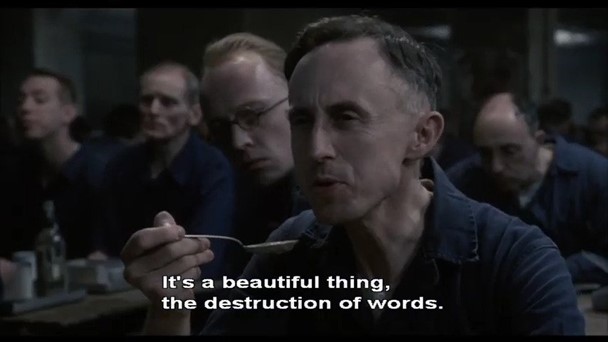
Image from 1984’s second—and most critically acclaimed—screen adaptation (1984). In this scene, Ministry of Truth
employee Syme explains his work to update the Newspeak dictionary to protagonist Winston.
October 25, 2024
https://www.opportunitynowsv.org/blog/proposition-doubleplusgood
Many voters are confused about initiatives that empower gov’t tax-raising schemes (Prop 5) or gift $1 billion to a failing, shrinking SJ school district (Measure R)—and for good reason: in a decisive report, SCC’s Civil Grand Jury observed (in 2022) that local ballot measures are regularly designed to “deceive” voters through feel-good, misleading, or straight manipulative language.
It is not uncommon for the public to be confronted daily with news and information through multiple sources—traditional television programming, 24/7 cable news, satellite radio, social media, and phone alerts. In the context of elections, voters’ busy lives can be overwhelmed with many different voices. County and state voter information guides are required by law to be mailed to every registered voter, but voters today do not have a lot of time to read these resources. As a result, the ballot measure question printed on the ballot itself becomes a key factor in the outcome of an election.
There is an expectation in California law that ballot questions be drafted in a manner that is not false, misleading, or partial to one side.1 But there are ways to work around it. … Many voters cannot comprehend the complicated language or the implications of that “yes” or “no” vote. In a perfect world, voters would have the luxury of time to research these issues. In reality, however, voters almost always rely on the language of the ballot measure question itself. …
It has been widely observed today that the 75-word ballot questions are being used as advocacy pieces, at the expense of fairness and impartiality. In an aptly titled report published in June of last year, the Alameda County Civil Grand Jury advocated for “The Need for Accuracy and Impartiality of Ballot Measure Questions.” The jury explained how and why the desire to achieve a certain outcome has tainted the process to produce ballot measure questions that are not accurate and impartial:
In general, we found ballot questions suffer from a “proponent’s bias” that is a natural outgrowth of the typical process through which questions are selected, drafted, and proposed. … In general, we found that ballot questions too often fall short of what voters have a right to expect in terms of transparency and impartiality, even when satisfying minimum legal standards.
The jury in Alameda reviewed and provided an in-depth analysis of six ballot questions to reach their conclusion. In so doing, they exposed the “tricks of the trade”—wording chosen for the sole purpose of increasing the odds of success at the polls. Adopting the same methodology as the Alameda report, the Civil Grand Jury reviewed past and upcoming ballot measure questions from local jurisdictions within Santa Clara County. The Santa Clara County Civil Grand Jury observed the same tricks and tactics used by governing bodies to deceive voters:
(1) Using “feel-good” words to garner voter approval. Measure F, November 2020, said “all funds spent locally,” which is meaningless when one pauses to think about it.
(2) Adding favorable language even where it plainly does not apply. Measure F, November 2020, said “independent audits, citizens’ oversight” where the underlying ordinance implementing the measure makes no mention whatsoever of audit and oversight requirements.
(3) Adding misleading words to lead voters astray. Measure S, November 2020, said “until ended by voters,” falsely implying that the measure itself provided for repeal or that voters would have an opportunity to repeal the tax when they did not; Measure L, November 2020, conveyed the same with “can be ended by voters.” Measure A, March 2017, said “[funds] cannot be taken away by the State,” falsely implying that the state may access local funds when it may not.
(4) Manipulating words to divert voters from what is actually at issue. Upcoming Measure N, November 2022, which seeks authorization of $572 million in school bonds costing approximately 3 cents per $100 of assessed valuation, states “no increase in tax rates.”
(5) Omitting relevant information necessary for voters to make informed decisions. Measure AA, November 2016, and Measure H, November 2014, made no mention of the tax increase that would be required to fund the school bonds that were at issue.
(6) Putting multiple issues on a single measure, ostensibly violating the single subject rule. Measure H, November 2020, sought to increase card room tax and the number of card tables allowed in gambling facilities. …
Once the decision is made by the government entity to spend the money to go to ballot, a lot of pressure is put on the entity to do whatever it takes to secure a win. For this reason, proponents of ballot measures stay focused on the result, hiring high-priced election consultants, attorneys, and opinion pollsters to carefully frame the ballot question to achieve the desired outcome. Successful elections will reward those that are behind them. It does not take much imagination to understand how this practice has evolved to become “high stakes.” For example, a school district superintendent who has successfully secured funding through school bond measures may parlay these wins to rally support for a more prestigious role or a position at a larger public institution.
On the other hand, if a measure fails, individuals’ livelihoods are at stake because someone will likely have to take the blame for it—usually either someone on staff or the board proponents of the governing body. This is why proponents advocate so strongly, often—as exemplified above—sacrificing context, clarity, truthfulness, and transparency in ballot question wording in favor of pure advocacy. The Civil Grand Jury learned from those in the ballot question business that it is understood that the drafter will make sure the statement is “lawful,” but it is also understood that it will not necessarily provide full disclosure.
Read the whole Grand Jury report here.
Additional article here.
Comment
Lydia Kou – Council Member & Former Mayor, City of Palo Alto
There are several Propositions in the November ballot that involves bonds … one in particular a legislature initiative Proposition 5 undermines people with blatant deceptive language. It pulls the wool over voters’ eyes. These legislators are enacting legislation to limit the power of the people and increase their cost of living.
Prop 5’s proponents say, “This isn’t a new tax.” That’s actually misleading. Prop 5 will result in many more taxes because it lowers the approval threshold and will make it easier to pass taxes and bonds, thus transferring the financial burden to taxpayers.
If passed, it makes it easier for the enactment of local and regional taxes and bonds.
These are special assessments that increase a homeowners’ annual property tax bill. This creates generational debt, and could cause those with limited income (like the retired) to fall behind on paying property taxes and lose their homes to foreclosure, thus making a person homeless.
The state legislators overspent the state’s budget, causing a huge deficit, and are now shifting the burden to the people to make up the deficit for more of their wasteful spending.
Santa Clara County’s Civil Grand Jury observed (in 2022) that local ballot measures are regularly designed to “deceive” voters through feel-good, misleading, or straight manipulative language. Link to the report is in the article.
I’m voting NO on Proposition 5. Lydia Kou for Change Lydia Kou