

BY J.K. DINEEN
May 17, 2025
https://eedition.sfchronicle.com/html5/reader/production/default.aspx
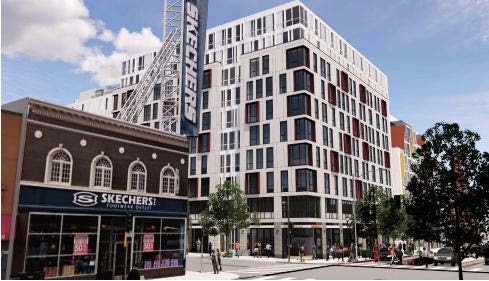 The site of a Mission District fire that killed a resident and displaced dozens of low-income tenants and small businesses a decade ago is set to become a 181-unit apartment building despite community efforts to derail the project.
In a 4-3 vote, the San Francisco Planning Commission approved the 10-story apartment complex at 2588 Mission St., a project opponents called “La Muerte de la Misíon,” referring to the 2015 fire that killed the tenant, injured six others and displaced 60 tenants and 26 businesses.
Several community groups had appealed the development, hoping that a required environmental study would kill the project or force the owner to sell it to the city for affordable housing.
Given the tragic history of the property, three of the four commissioners who voted to allow the project go forward said they held out hope that property owner Hawk Lou would sell the property to a nonprofit developer.
As approved, roughly 9% of the 181 units will be below market rate.
The fight over the contentious project laid bare how tough state housing laws have changed land use politics in San Francisco, giving developers the power to win streamlined approvals even if facing widespread neighborhood opposition. In this case, Lou took advantage of density bonus laws that allow builders to avoid lengthy environmental review.
David Blackwell, an attorney for Lou, stressed that under state housing law commissioners could reject the project only if they could prove it would have “a specific adverse impact on public health or safety.”
“At the end of the day, there is only one standard that applies here, and if you are going to follow state law, you have to approve this project,” Blackwell said. “The state law is crystal clear about what the standard is.”
United to Save the Mission organizer Larisa Pedroncelli argued at the hearing that the development violates a different set of housing laws that require communities to “affirmatively further fair housing,” a centerpiece of the state-mandated “housing element” that requires San Francisco to plan for 82,000 units by 2031.
Pedroncelli said the fact that 2588 Mission calls for 91% of the units to be market rate would have the effect of “deepening existing disparities” and mean families “already living in overcrowded conditions or on the street” would have less access to housing.
Only one speaker out of dozens spoke in favor of the development. Prohousing advocates from YIMBY Action and the Housing Action Coalition, who often show up to support projects, did not speak.
Opponents blamed Lou for not rebuilding the site to allow displaced families to return. Instead the property sat abandoned for years while two more fires further damaged the building, which was eventually red-tagged and demolished.
In addition, dozens of families sued Lou, accusing their former landlord of maintaining the century-old structure so poorly that a fire was all but inevitable.
Planning Commissioner Sean McGarry, who voted to approve the project, called the site “a graveyard minus a tomb.”
“It’s scar on top of scar on top of scar,” he said. “You have fire, you have water damage, you have another fire, you have another fire on top of that. All the while the community is watching it. Basically it’s heartbreaking.”
Commissioner Theresa Imperial, who voted against the project, called the history of the property “unsettling” and said the city “didn’t do enough due diligence to find resources to do 100% affordable housing.”
“It’s a very sad situation. I can’t in good conscience approve this project,” Imperial said. “The community deserves a lot better than the reality that is before this commission.”
Planning director Rich Hillis said department staff had put Lou’s attorneys in touch with several nonprofit and for-profit developers to see whether a deal could be reached, but those talks did not bear fruit. The Chronicle has previously reported that other efforts by the city to acquire the property had stalled because the parties could not agree on a price.
While commissioner Derek Braun said there was no legal rationale for denying the project, he urged Lou “to choose a different path.”
“This really shouldn’t be the end of the road,” he said. “There can be something better here.”
McGarry said the site, which has grass growing on it, is not currently helping the neighborhood.
“We have a fenced-off piece of property that looks great in the winter when there is rain and terrible in the summer when it’s dried out,” he said. “We will have to move on. The community will have to move on. Something is going to be built there.”