

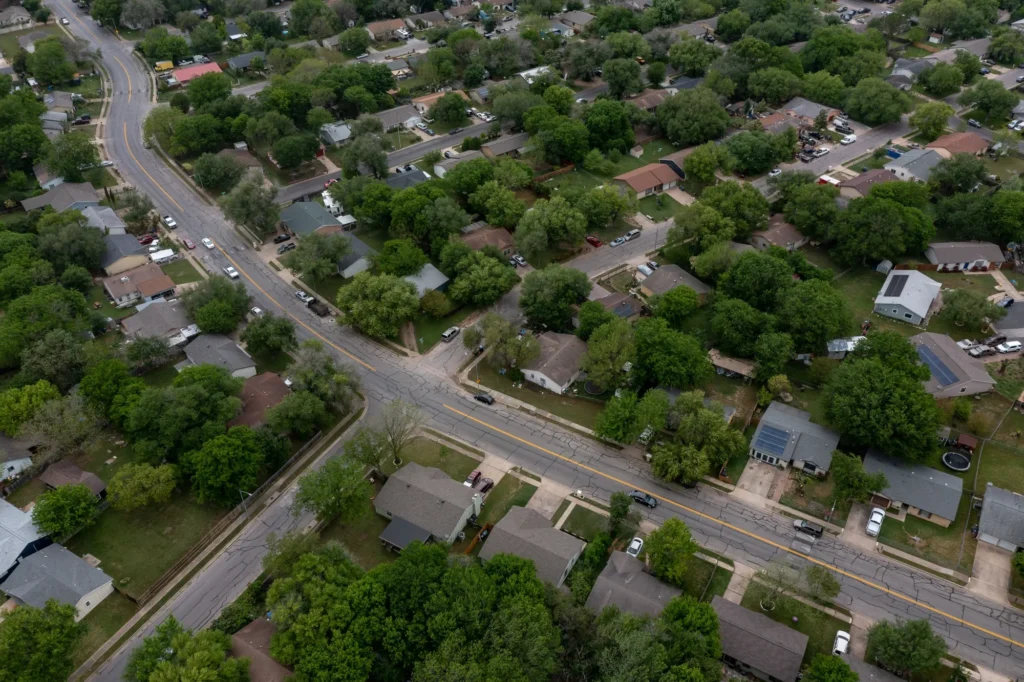
 Homes in the Dove Springs neighborhood of Austin in 2022. Photographer: Jordan Vonderhaar/Bloomberg
In her new book, lawyer and architect Sara Bronin shows how land use regulations shaped US cities and makes a case for using these rules for progressive aims.
By David Zipper
September 23, 2024 at 5:00 AM PDT
https://www.bloomberg.com/news/features/2024-09-23/zoning-s-hidden-power-is-the-key-to-understanding-cities?
No longer dismissed as an insomnia-curing corner of local governance, zoning is having a moment. It’s at the heart of the pro-housing Yes In My Backyard — or YIMBY — movement, which seeks to reform the rules that mandate the construction of single-family homes across much of the US, and the arcane details of land use policy are being debated in national outlets and city councils across the US. In much of this discourse, zoning is the clear villain, blamed for feeding societal ills ranging from housing costs to racial discrimination to greenhouse gas emissions.
In her new book Key to the City, Sara Bronin examines zoning with a critical but sympathetic eye. Bronin brings deep experience to the topic, having studied zoning as an architect and lawyer before overhauling the land use regulations of Hartford, Connecticut. A professor of architecture and planning at Cornell University (and an occasional Bloomberg CityLab contributor), she is currently on leave to chair the federal Advisory Council on Historic Preservation.
Impenetrable though zoning may seem, Bronin believes it provides an essential lens for understanding how American cities operate — for better and for worse:
Zoning hides in plain sight. The home, workplace, learning environment, restaurant, corner store, nightlife venue: at every turn, behind whatever you are looking at — whatever you are doing — zoning is there, surreptitiously dictating our lives with its fateful rules. If we can understand its power, then we can also learn how to improve it.
CityLab contributor David Zipper spoke with Bronin about the potential for zoning to be a force for urban progress. Their conversation has been edited for concision and clarity.
You currently live in Georgetown in Washington, DC, which you call “arguably the best neighborhood in the United States.” I also live in DC, so I have to ask: What’s so great about Georgetown?
As a neighborhood, Georgetown is walkable, mixed-use, and historic. Those features combine to create a sense of place and community because it’s so dense, and because it has a diversity of housing stock. It was built at a time that didn’t prioritize the car, and it’s a livable place. Since zoning often now prevents us from building coherent, walkable communities, Georgetown offers lessons.
 For instance, single-family zoning is the most common form of zoning in the country, and it doesn’t allow corner stores. But Georgetown’s zoning expressly allows for corner stores within the residential blocks. They’re often the gathering places for the neighborhood, and they’re also pretty convenient. Many of my daily needs are met by these little corner stores sprinkled throughout the neighborhood. They add a lot to someone’s day-to-day experience.
Fair enough. To go backwards in time, you grew up in Houston, which is famous for being a city without zoning. In your book, you write about how Houston’s laissez-faire approach toward development affected you and your family. I’m curious: Were you aware of zoning’s influence at the time?
Absolutely not. I wasn’t aware of zoning at all, but I did know that Houston sprawled beyond comprehension. Everything that my family did required a car; even driving to school took one hour each way. As a child, I managed to figure out how to spend hours in a car and do my homework there. I didn’t realize until toward the end of architecture school that zoning codes existed. That’s when I became curious about their impact on our lives.
I think my lack of knowledge about zoning and its effect on the place where I grew up is a pretty consistent experience for people across the country. Zoning is a hidden power that exists all around us, but one we don’t really understand.
I’d like to ask you about Austin, where you lived during college. Austin’s 6th Street is famous for its bars and clubs — you call it “pure linear debauchery” in your book and blame bad zoning as well as the SXSW festival. If I can play devil’s advocate, I could argue that people like going to those bars on 6th Street, which must be making money or they would have closed. And if nearby residents or businesses are annoyed about the nightlife, there are lots of other neighborhoods they could move to. What’s so bad about the free market shaping 6th Street to become what it is?
To me, it’s a quality of life issue. I embrace nightlife as much as the next person, and Austin has always had that sense of joie de vivre. But there’s a limit to the burdens that neighbors and the city as a whole should be asked to bear to allow extreme behavior like what we see on 6th Street. During the day, that street is almost desolate because so many of the establishments have turned into what I call high-volume alcohol dispensaries, as opposed to creating a round-the-clock environment where some places might be community assets, too.
It’s zoning that allows these kinds of abuses to concentrate in Austin in a way that you might not see in other places like Nashville, which is the counterexample I used in my book.
 Much of your book outlines ways zoning can improve people’s lives. But you also acknowledge that zoning has contributed to residential segregation, the high cost of housing, and autocentric urban design, which are three of this country’s biggest challenges.
Would the US be better off without any zoning at all?
Attorney and Cornell architecture
professor Sara Bronin is also the
founder of the National Zoning Atlas.
Photographer: Jane Shauck
It’s hard to defend zoning as it’s been practiced in the United States for the last half of the 20th century. In many places, we’re stuck with that legacy, because zoning codes don’t change often enough. But ultimately, zoning is a hopeful act by a community trying to shape its future growth.
Zoning powers are already laid out in every state for local governments to use. Rather than dwell on the many terrible aspects of zoning, some of which I documented in the book, I wanted to present the opportunity that zoning provides for people to help their community grow in a more equitable and sustainable way.
Was there something about zoning that you could understand only after personally overseeing it in Hartford?
What surprised me most was that so many advocates and community leaders had identified problems in their neighborhoods, but they had never connected the dots between those problems and zoning.
For instance, Hartford is a city of avenues. One road that I focus on in the book is Albany Avenue, which historically was beautiful, lined with shops and houses, some of them quite grand. In part because of zoning, that avenue became very auto-oriented. That was why so many people in that neighborhood complained about cars speeding, or about how dangerous it was to walk there, or about residents having some of the highest asthma rates in the country. That avenue is a place that was eroded in part because of zoning. My hope is that the new zoning code, which got rid of parking minimums and does not allow drive-throughs, will help it recover.
Hartford’s new zoning codes included several restrictions on drive-throughs, which led to numerous lawsuits. Why was that a fight worth having?
Drive-throughs require large curb cuts, so you’re expecting anybody on foot to walk across a large expanse of driveway. At any moment a car might hurtle across, so drive-throughs detract from the walking environment in a dense city. You can see their effects all over Hartford: Lots of paving leading to more stormwater runoff, unsafe pedestrian environments, and potentially to high rates of obesity and diabetes given the nature of fast food.
It’s not just drive-throughs, by the way. For the same reasons, Hartford’s zoning codes now restrict car washes and gas stations. In general, auto-oriented uses are not really compatible with an historic city.
In your book you suggest that zoning explicitly include streets. How would that work?
The way it worked in Hartford was that we partnered with the Department of Transportation’s planners, who were familiar with street design. We decided together that we could agree on complete streets principles that would be included in the zoning code, which now provides a menu of streets and requirements of how building-to-building streetscapes will be developed. That includes not just the roadways, but also pedestrian infrastructure, street trees and bike lanes. We felt that doing so would give us a better handle on the important public realm that connects individual zoning laws. These street types that we included in the zoning code have since been used in city developments that have created new roads.
Let’s talk about housing. In your book, you claim removing single-family zoning requirements won’t necessarily increase housing construction. Why not?
Simply changing the number of units for that may be built on a lot is not enough to ensure housing can be built. As I described in a paper called Zoning by a Thousand Cuts, each lot in a zoned city is subject to a variety of other rules, including minimum lot sizes, setback requirements, building height caps, maximum number of units and parking requirements. These zoning rules often do more to constrain housing than people realize.
 A city official in Colorado Springs, Colorado, studies a zoning map in 2016.Photographer: Michael Reaves/Denver Post via Getty Images
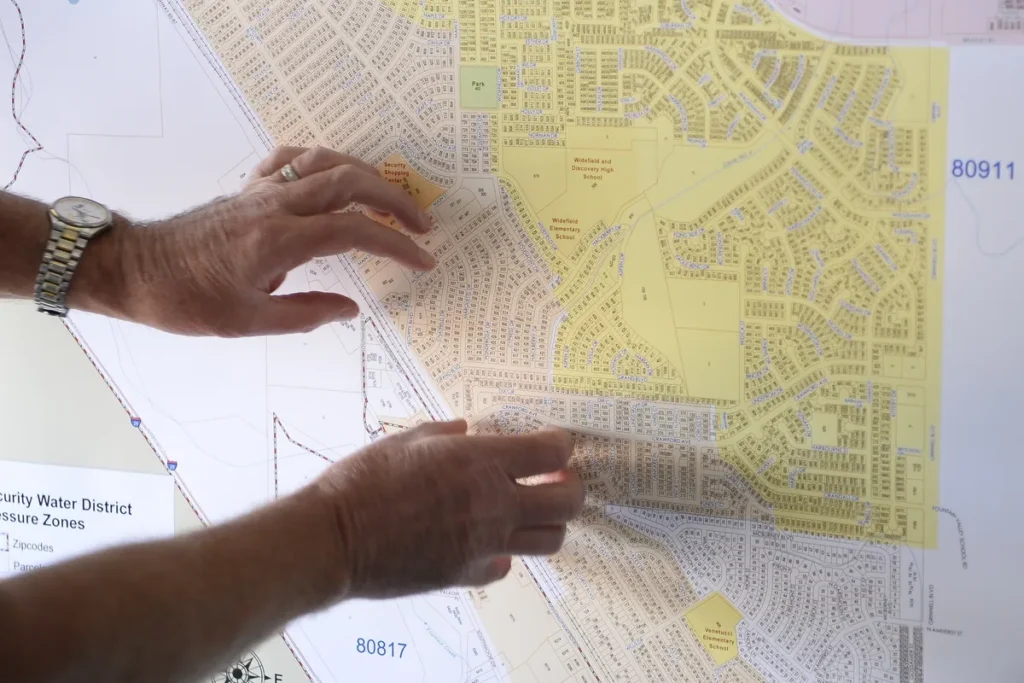 A city official in Colorado Springs, Colorado, studies a zoning map in 2016.Photographer: Michael Reaves/Denver Post via Getty Images
What is the justification for minimum lot sizes, anyway?
I don’t know. I think that minimum lot sizes originally seemed like a way to lower density and provide light and air to occupants. But it has sprawled out of control — pardon my pun. These lot sizes were not included in the oldest zoning codes, only emerging in the 1950s and 1960s, and they’ve only increased. The people who should care most about minimum lot sizes are environmentalists, because these policies are a huge contributor to the destruction of forests as well as important agricultural landscapes.
Single-family zoning and parking minimums now attract a lot of attention. But are there other zoning elements that escape notice but can have an outsized impact on housing?
We don’t know. That’s in part because we haven’t collected zoning data at scale or dug into it, but we’re starting to do that now. I’ve developed a project called the National Zoning Atlas, which logs 120 different characteristics for each zoning district. It now includes zoning for about 4,200 jurisdictions out of around 30,000 nationwide. We’re hoping to use that data to understand which levers of zoning have the most impact on housing production, in particular.
A screenshot from the National Zoning Atlas zooms in on downtown Hartford, Connecticut.Source: National Zoning Atlas
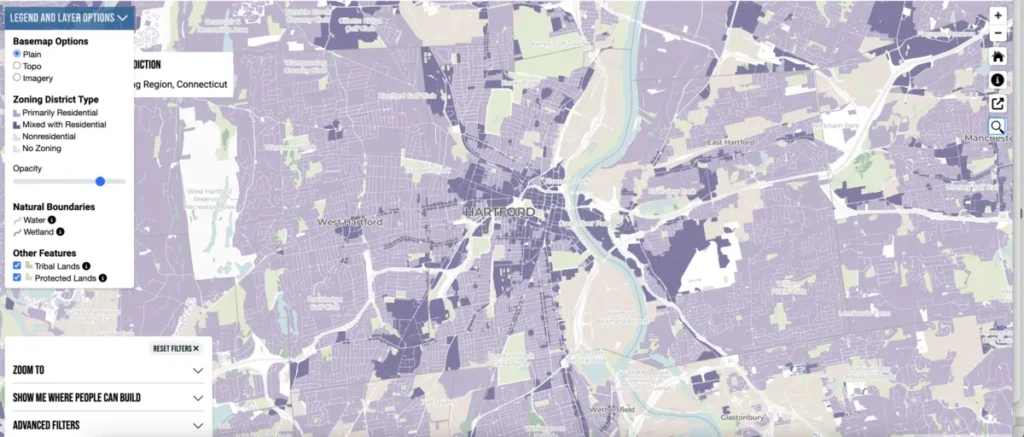 A screenshot from the National Zoning Atlas zooms in on downtown Hartford, Connecticut.Source: National Zoning Atlas
So far, one finding that shocked me was from Denver. We found that 96% of land in the metro Denver area is zoned to require two acres per single-family house. That’s even higher than Connecticut, which in my mind is a highly exclusionary and segregated place.
You work in historic preservation now. How should preservation affect zoning?
It’s really important for preservationists — and I certainly call myself a preservationist — to be much more active vocalizing the ways that historic preservation can go hand-in-hand with building new housing. We’ve seen some people use preservation to block new housing proposals. That’s wrong. Preservation in this country has always been adapted to meet contemporary needs with buildings modified by their occupants. It’s only been recently when some people have taken the view that change to those buildings is somehow improper. So we really have to ensure that historic preservation is not used to achieve ends that have nothing to do with preservation and are contrary to the way that historic neighborhoods organically and densely developed.
You call yourself a preservationist. Do you also call yourself a YIMBY?
Oh yeah. 100%.
One urban challenge that seems to be attracting more attention is the lack of public bathrooms in US cities. Could zoning help with that?
Interesting question. Zoning can be applied to public parks, but I hadn’t thought about a public provision that bathrooms be included. Another possibility would be to offer incentive zoning, which in cities like New York City and Seattle is intended to inspire private developers to provide public benefits — things like gardens and childcare. Those provisions could be used to encourage public bathrooms, too.
Is it wise to use zoning to deputize the private sector to provide amenities for the public?
The successes of privately provided public benefits depends a lot on design. In too many cases, we see that private property owners have taken advantage of incentive zoning to offer what they say is a public benefit, but one that isn’t actually accessible in a convenient way. An example would be an outdoor space that’s hidden from view. Incentive zoning has to be carefully articulated in the zoning code.
Finally, what would you say to urbanist activists who argue zoning is an original sin in the United States, and that it should simply be abolished?
Good luck with that. Zoning is here to stay. I’m optimistic that with greater public awareness we’ll see zoning being used for good. But talk to me again in a decade. We’ll see where we are then.
From the article:
You currently live in Georgetown in Washington, DC, which you call “arguably the best neighborhood in the United States.” I also live in DC, so I have to ask: What’s so great about Georgetown?
As a neighborhood, Georgetown is walkable, mixed-use, and historic. Those features combine to create a sense of place and community because it’s so dense, and because it has a diversity of housing stock.
But are there any high-rises? It’s an old neighborhood, like many on the east coast, though probably more wealthy. I doubt there are any skyscrapers.